Finally, Hard Numbers Confirm What We’ve Known for Decades: Full-Band Vibration Isolation Matters
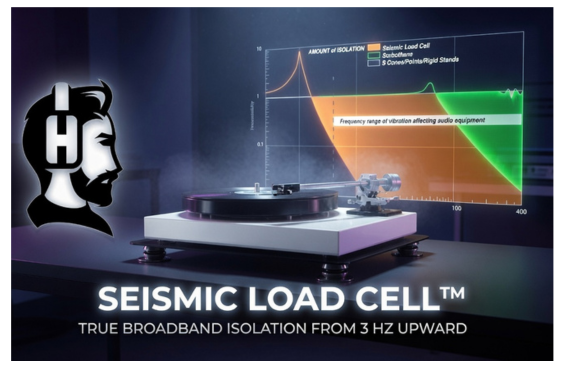
At Townshend Audio, we’ve spent years refining the art and science of protecting sensitive audio equipment from structural vibration. Our patented Seismic Load Cell™ technology—featuring a precision high-tensile steel spring enclosed in a flexible synthetic rubber jacket with controlled air damping—has always been designed to deliver true broadband isolation from 3 Hz upward, across the entire audio band and in all three planes of movement.A recent peer-reviewed study has now put serious, independent numbers behind the very problem we’ve been solving. In June 2025, researchers Aleksandra Sawczuk and Bartłomiej Chojnacki published “Mitigation of Structural Vibrations in Sensitive Audio Devices: A Study on Isolation Materials for Lightweight Turntables.” The paper (available via PubMed Central) and subsequent coverage, including a detailed report on Headphonesty, examined how different supports protect lightweight turntables (under 10 kg) from real-world structural disturbances such as footsteps and moving furniture.

Using a calibrated Norsonic Nor277 tapping machine to simulate impacts and precise accelerometers placed on the chassis, platter, tonearm, and cartridge, the team compared rigid wood blocks (baseline), factory feet, elastomer pads, steel springs, and two types of wire-rope isolators. Measurements focused especially on the critical 5–15 Hz range where tonearm-cartridge resonances live, as well as mid-band behaviour. The results were clear:
- Steel springs delivered the strongest and most consistent overall structural attenuation, particularly against low-frequency footfall energy in the 8–15 Hz and 32–64 Hz bands.
- Elastomer pads performed best in a narrower mid-frequency window (roughly 17–32 Hz), thanks to their high damping properties, but were less effective at the extremes.
- Factory feet offered poor isolation and sometimes performed worse than the rigid baseline.
- Certain rope isolators showed mixed or even counterproductive results at the cartridge—the most vulnerable point, where mechanical energy can directly colour the audio signal.
The study underscores a fundamental truth: effective isolation for lightweight turntables cannot rely solely on mass loading or single-material solutions. Low-frequency structural energy must be decoupled, while mid- and higher-frequency energy and any residual spring “ringing” must be controlled. Stock supports simply do not provide adequate defence across the band.This is precisely the challenge our Seismic Load Cell™ was engineered to meet.Bare undamped steel springs excel at low-frequency isolation by creating a soft suspension with a very low natural frequency. However, without additional damping they remain vulnerable to self-resonance and the transmission of higher-frequency energy—leaving residual ringing that can still reach the sensitive cartridge and tonearm assembly. The study’s results highlight this limitation: while springs handled the critical low-frequency footfalls most effectively, they do not inherently solve the mid- and high-frequency issues on their own.At Townshend, we address the complete problem with a purpose-built solution. Each Seismic Load Cell contains a high-grade alloy steel compression spring surrounded by a flexible synthetic rubber jacket. A small air valve creates movement-sensitive air-resistance damping. This air-damped rubber jacket actively suppresses high-frequency ringing and residual energy—precisely the mid- and upper-band control that pure undamped springs lack—while the spring itself delivers the ultra-low-frequency isolation that elastomers alone struggle to achieve.The result is a true mechanical low-pass filter:
- Isolation begins at approximately 3 Hz.
- Free movement is allowed in vertical, lateral, and horizontal planes.
- Residual oscillation is rapidly dissipated by the air damping, so the system settles quickly without prolonged ringing.
- Attenuation increases progressively with frequency (typically 12–18 dB per octave depending on configuration), delivering near-complete isolation through the critical audio range.
Because every Load Cell is individually calibrated to the specific mass and balance of the equipment it supports, the suspension remains optimally tuned. Whether under a lightweight turntable, a DAC, an amplifier, or loudspeakers, the equipment effectively floats free of structural-borne vibration, airborne energy, and self-generated disturbances.The Krakow study is welcome independent validation. It demonstrates with measured data what careful listening and engineering have long shown: protecting the complete frequency band—especially the low-frequency region that reaches the cartridge—requires more than stock feet, single-purpose pads, or undamped springs. Only a properly engineered combination of spring isolation and controlled air damping covers the entire band that matters to the music.We are gratified to see rigorous measurement finally applied to this long-overlooked aspect of analogue playback. For those seeking the quietest possible foundation for their turntable or complete system, the Seismic Load Cell™ and the platforms, pods, and podiums built around it remain our proven solution—now with independent research reinforcing the underlying principles.Explore the full range of Townshend Seismic Isolation products and discover how floating your system can transform the listening experience.
https://www.headphonesty.com/2026/07/first-turntable-vibration-study-tested-supports/