"First Impressions: It’s early days, but the system already feels more composed. There’s a noticeable sense of “blacker” backgrounds and improved low-level resolution. I’m looking forward to extended listening sessions to fully evaluate the difference.A big thank you to the team at Townshend Audio — I hope everyone there is doing well! Your products continue to inspire creative thinking in the audiophile community."
At Townshend Audio, we’re always inspired by the inventive ways audiophiles apply our Seismic Isolation technology. While our Seismic Isolation Corners are the go-to solution for most equipment racks, one customer with a long, full-width wooden hi-fi rack developed a highly effective alternative using our Speaker Bars.
Why Isolate Just the Speakers? Float the Entire Rack
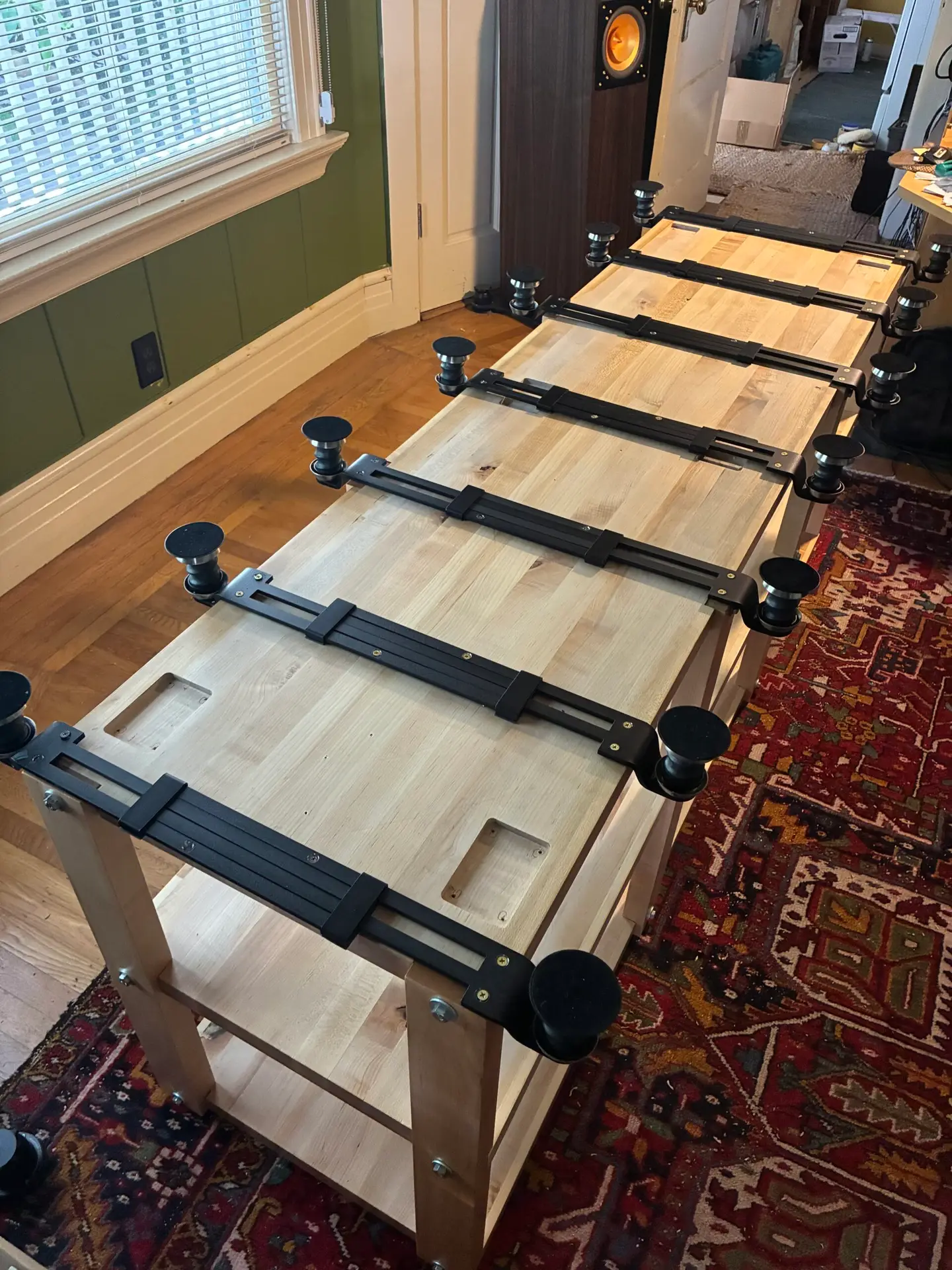
Normally, we recommend Townshend Seismic Corners for isolating complete audio racks. These compact modules slip under the corners and deliver outstanding vibration isolation. However, certain large or uniquely structured racks benefit from a different approach. This creative enthusiast turned to our Townshend Speaker Bars — the same high-performance isolation bars designed for loudspeakers and subwoofers — to successfully float his entire equipment rack.
The Installation
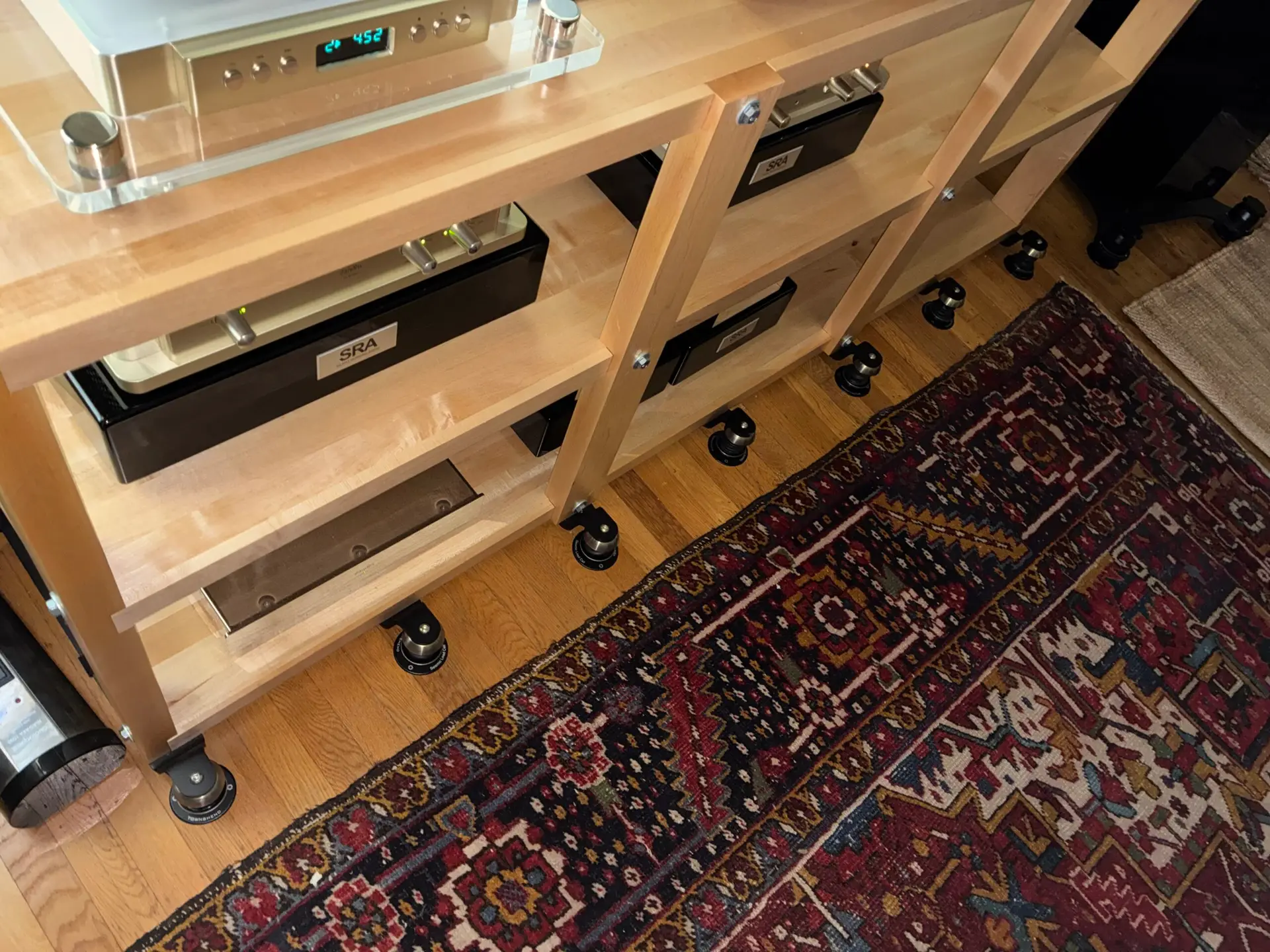
By mounting the Speaker Bars along the underside of the rack (replacing the original casters), the full hi-fi stand is now decoupled from the floor. Here are photos of the project:
Due to the rack’s central upright supports, the bars could not be mounted in one continuous line, but the system performs extremely well.
Townshend Seismic Isolation Technology – Effective from 3Hz
What makes this solution so effective is Townshend’s advanced Seismic Isolation system. Using high-tensile steel springs with air damping, our technology acts as a true mechanical low-pass filter with a resonant frequency of just 3 Hz.
This ultra-low tuning ensures isolation across the entire audio spectrum and well below it — blocking floor-borne vibrations from footsteps, traffic rumble, subwoofers, and structural resonances in the critical 10–40 Hz range.
Many alternative isolation methods, such as rigid cones, spikes, or particle-damped platforms (including those using sand-filled chambers), primarily address higher frequencies through mass loading and friction. They often allow low-frequency energy to pass through or even couple it into the equipment. In contrast, Townshend’s compliant spring-based system provides true broadband isolation in all three planes — vertical, horizontal, and rotational — resulting in blacker backgrounds, tighter bass, clearer transients, and a more open soundstage.
Benefits of Floating the Complete Rack
Isolating the entire rack means every component — turntables, phono stages, DACs, amplifiers, and streamers — benefits from reduced vibration. This is especially valuable for vibration-sensitive equipment like turntables and tube electronics.
Thank You to Our Innovative Customer
We’d like to thank this creative audiophile for sharing his project and his kind wishes. Everyone at Townshend Audio is doing very well, and we love seeing such resourceful applications of our products.
If you own a large, long, or non-standard hi-fi rack and want to explore the best isolation solution — whether Seismic Corners, Speaker Bars, Seismic Pods, or a full Seismic Isolation Platform — contact our team. We’re happy to advise on the ideal configuration for your setup.
Have you isolated your equipment rack with Townshend Seismic technology? Share your photos and experiences in the comments or send them to us — we may feature your setup in a future article.
Discover Townshend Seismic Isolation
Seismic Isolation Corners (/seismic-isolation-corners/) | Speaker Isolation (/speaker-isolation/) | Seismic Pods (/seismic-isolation-pods/)
Innovation through isolation.
Happy listening!