

The Precedence Effect and Super-Tweeters: Why the Fastest Leading Note Can Make Music Sound More Alive.
Chasing the Invisible Spark. Imagine a world where the tiniest, fastest shimmer at the leading edge of a note — that fleeting ultrasonic whisper riding the attack of a cymbal crash or the pluck of a string — could rewrite your entire perception of music. Not by being “heard” in the conventional sense, but by hijacking the brain’s ancient survival circuitry to deliver sharper imaging, deeper bass, and a soundstage that feels almost indecently alive.
Application to Music Perception
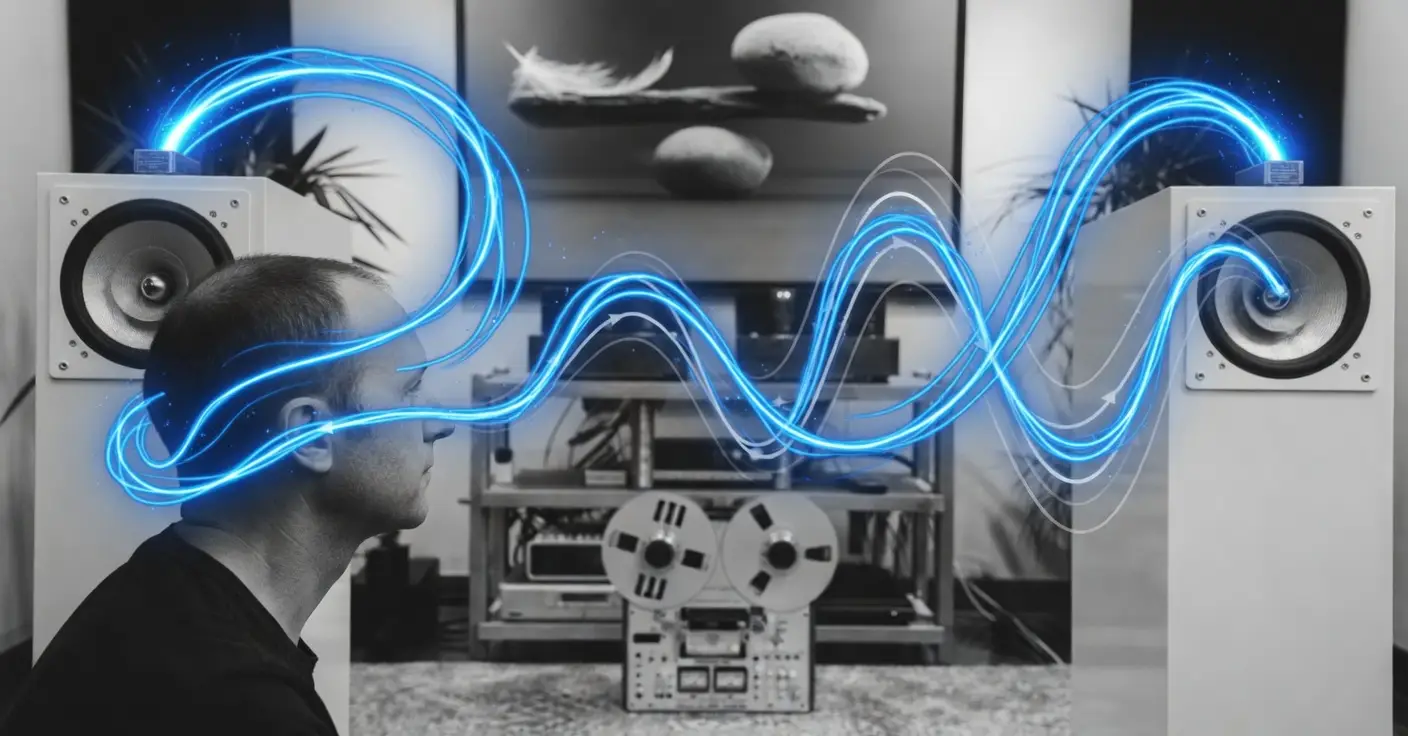
Lock onto the direct sound’s leading edge for precise imaging and source separation. Fuse early reflections into a coherent, spacious percept without echo. Enhance perceived clarity, “air,” and attack definition. In real listening rooms or multi-driver speakers, small timing differences between drivers or between direct and reflected sound create opportunities for precedence to operate. A transducer capable of delivering an exceptionally fast, low-mass leading wavefront at high frequencies can dominate this process, suppressing smeared or delayed components from conventional dome tweeters.
Townshend Maximum Supertweeters – Built for Speed
At Townshend Audio, the debate around super-tweeters — transducers that extend well beyond the traditional 20 kHz limit of human hearing — remains very much alive. While recent articles, such as the one published by Headphonesty in September 2025, have declared the “super-tweeter myth” scientifically debunked, we believe a closer examination reveals a far more nuanced and interesting reality. Our Townshend Maximum Supertweeters, with their ultra-light aluminium ribbon diaphragms and extended response reaching 90 kHz, continue to deliver meaningful improvements in imaging, soundstage depth, transient clarity, and even perceived bass tightness for listeners seeking the highest levels of musical perfection. Rather than relying solely on controversial claims of direct ultrasonic hearing, the well-established Precedence Effect offers a credible and scientifically grounded explanation for many of the benefits we observe.
Enhancers that bring “utmost pleasure” even to standard CDs, these devices from British innovator Max Townshend have earned cult status for claims of tighter bass, holographic imaging, and emotional immediacy — effects that seem to defy the conventional 20 kHz limit of human hearing
The beauty is that almost any speaker can benefit. You simply add the Townshend units, adjust the level for natural blending, and they start contributing gently from around 6–12 kHz while extending cleanly to 90 kHz.
What Is the Precedence Effect?
Also known as the Haas Effect or the Law of the First Wavefront, the precedence effect describes how the human auditory system processes multiple similar sounds arriving in quick succession. When sounds reach the ears within a short time window (typically 1–50 milliseconds, depending on the signal), the brain fuses them into a single auditory event. The first-arriving wavefront dominates perception of direction, clarity, and timbre, while later arrivals contribute to loudness, richness, and spatial impression without being perceived as separate echoes. Key foundational research includes:
Key foundational research includes:
Wallach et al. (1949): Demonstrated that localisation is determined primarily by the leading sound, with fusion windows extending up to 5 ms for clicks and 30–40 ms or more for complex signals such as music.
Haas (1951) showed that a delayed reflection could be up to 10 dB louder than the direct sound and still enhance perceived volume and width without disrupting localisation.
Litovsky et al. (1999): Provided a comprehensive review distinguishing between summing localisation, localisation dominance, and echo suppression, highlighting the effect’s robustness with broadband transients typical in music. Subsequent studies have confirmed that high-frequency content in the leading edge of transients strengthens the precedence effect by providing sharper, more distinct onsets.
Why This Matters for Music Reproduction:
Music is fundamentally transient-rich. The initial attack of notes — whether from a plucked string, struck cymbal, or vocal consonant — contains critical information about timbre, location, and emotional impact. The precedence effect allows the auditory system to prioritise the direct sound for precise imaging and source separation, fuse early reflections into a coherent spacious soundfield, and enhance perceived clarity and “air”.In loudspeaker systems, even small differences in transient response between drivers or between direct and reflected sound create conditions in which the precedence effect operates.A super-tweeter capable of delivering an exceptionally fast, low-mass leading wavefront in the upper frequency range can dominate this process, resulting in cleaner and more decisive auditory objects. Townshend Maximum Supertweeters – Designed for the Fastest Leading Note.
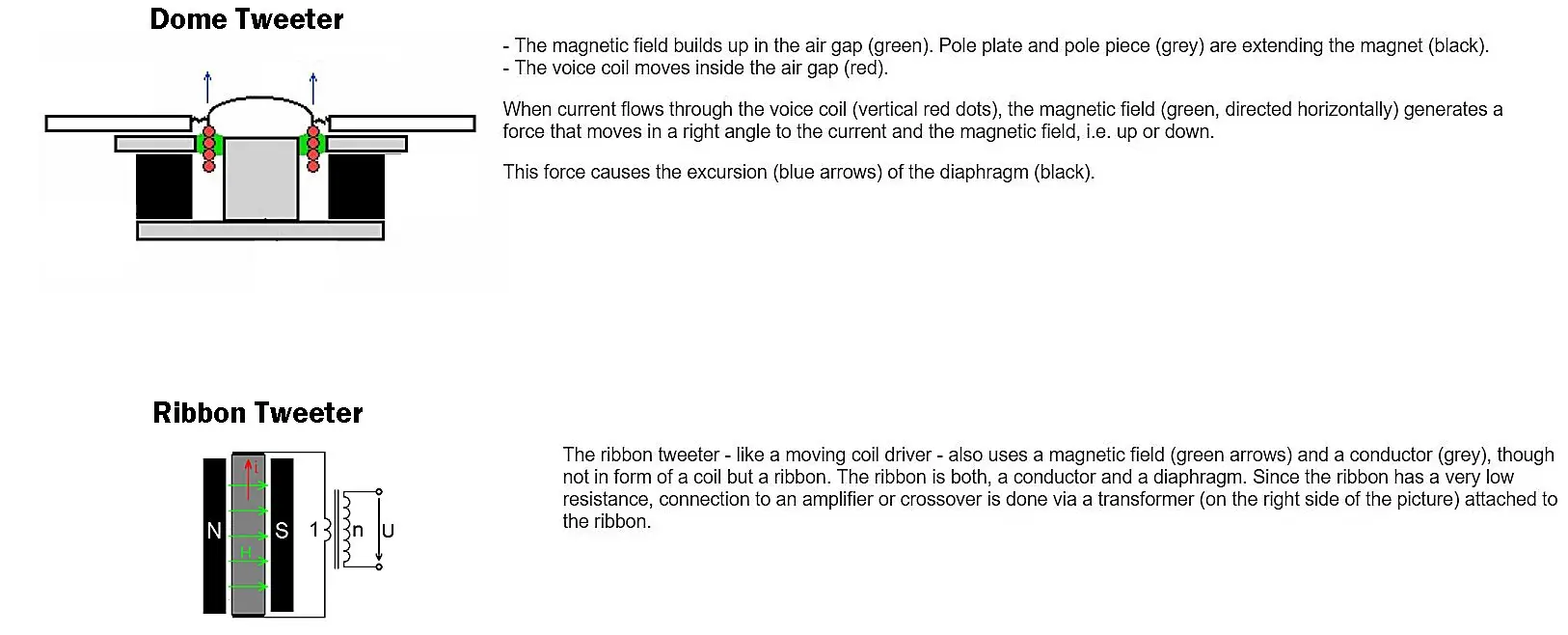
Dome vs Ribbon
Our Maximum Supertweeters exemplify this approach. They feature an ultra-fine, ultra-light pure aluminium ribbon (approximately 5mm × 25mm × 0.01mm, weighing just 0.003g) powered by powerful neodymium magnets. This delivers an extremely rapid transient response with minimal resonance. Conventional dome tweeters have heavier diaphragms and slower rise times, meaning their leading edge is somewhat rounded or smeared by comparison. Our ribbon design accelerates incredibly fast, providing the fastest possible leading note. Max Townshend has explicitly referenced the precedence effect in our design philosophy: the faster-rising wavefront from the supertweeter takes perceptual precedence over the slower output of conventional tweeters.
Understanding the Limits of Conventional Hearing Tests
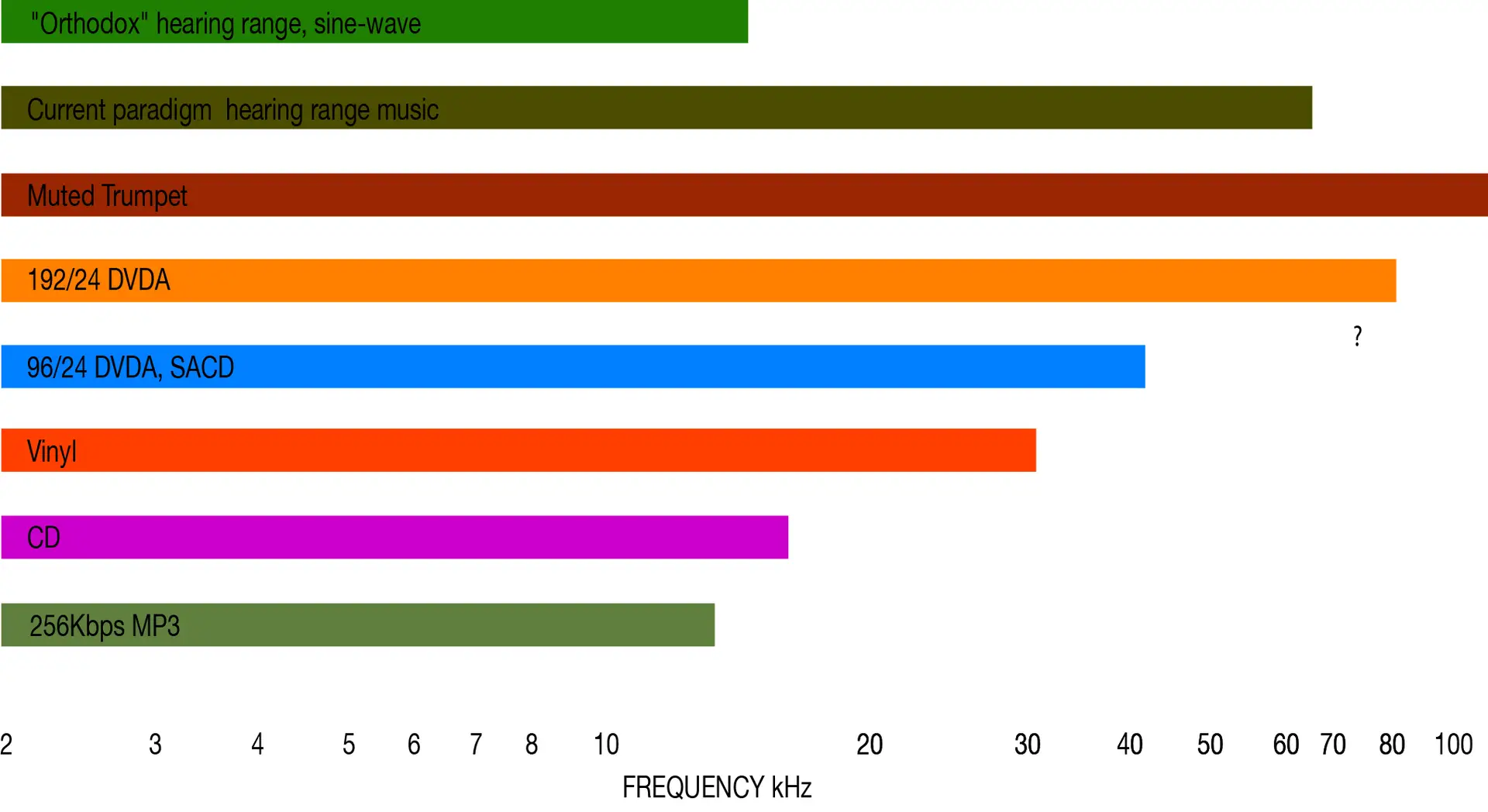
It is worth noting that conventional hearing tests (pure-tone audiometry) use simple, isolated sine waves — pure tones — to measure hearing thresholds. While useful for basic screening, these tests do not fully reflect how we perceive real-world sound. Sounds in nature and music are complex, broadband, and transient-rich, containing harmonics, rapid attacks, and energy across many frequencies simultaneously. This complexity means our auditory system can respond to high-frequency content in ways that pure-tone testing alone cannot capture.
There is life beyond 20kHz!
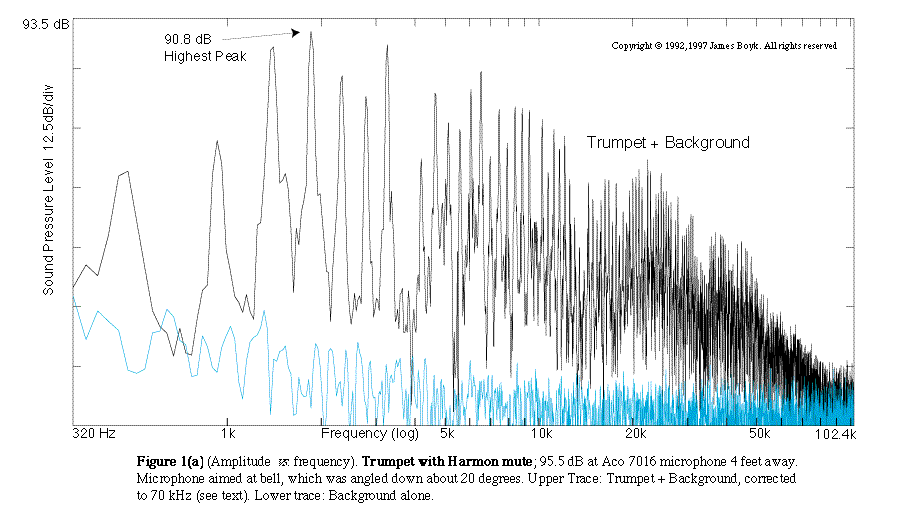
We also believe real musical instruments produce meaningful content above 20 kHz. As James Boyk famously demonstrated in his paper “There’s Life Above 20 Kilohertz!”, many instruments — from cymbals and muted trumpets to violins and percussion — generate significant ultrasonic energy. This content, even if subtle, contributes to the natural timbre and realism we strive to preserve.
At Townshend Audio, we understand that super-tweeters are not for everyone — and they don’t need to be. However, for those who want and need more from their music — those who pursue absolute authentic reproduction and refuse to settle for “good enough” — the Maximum Supertweeters often become an essential part of the listening experience. As many owners have eloquently put it, adding them is “like salt added to food” — you don’t notice it’s there until it’s missing, yet it transforms the entire experience. Others have gone further, saying that “turning them off feels like masochism.”We always encourage serious listeners to try them in their own system. If you love what they do, keep them. If not, simply return them. The pursuit of musical truth has always been a personal journey, and for those chasing the final degree of realism and emotional connection, the fastest leading wavefront may be exactly what you’ve been missing.


