

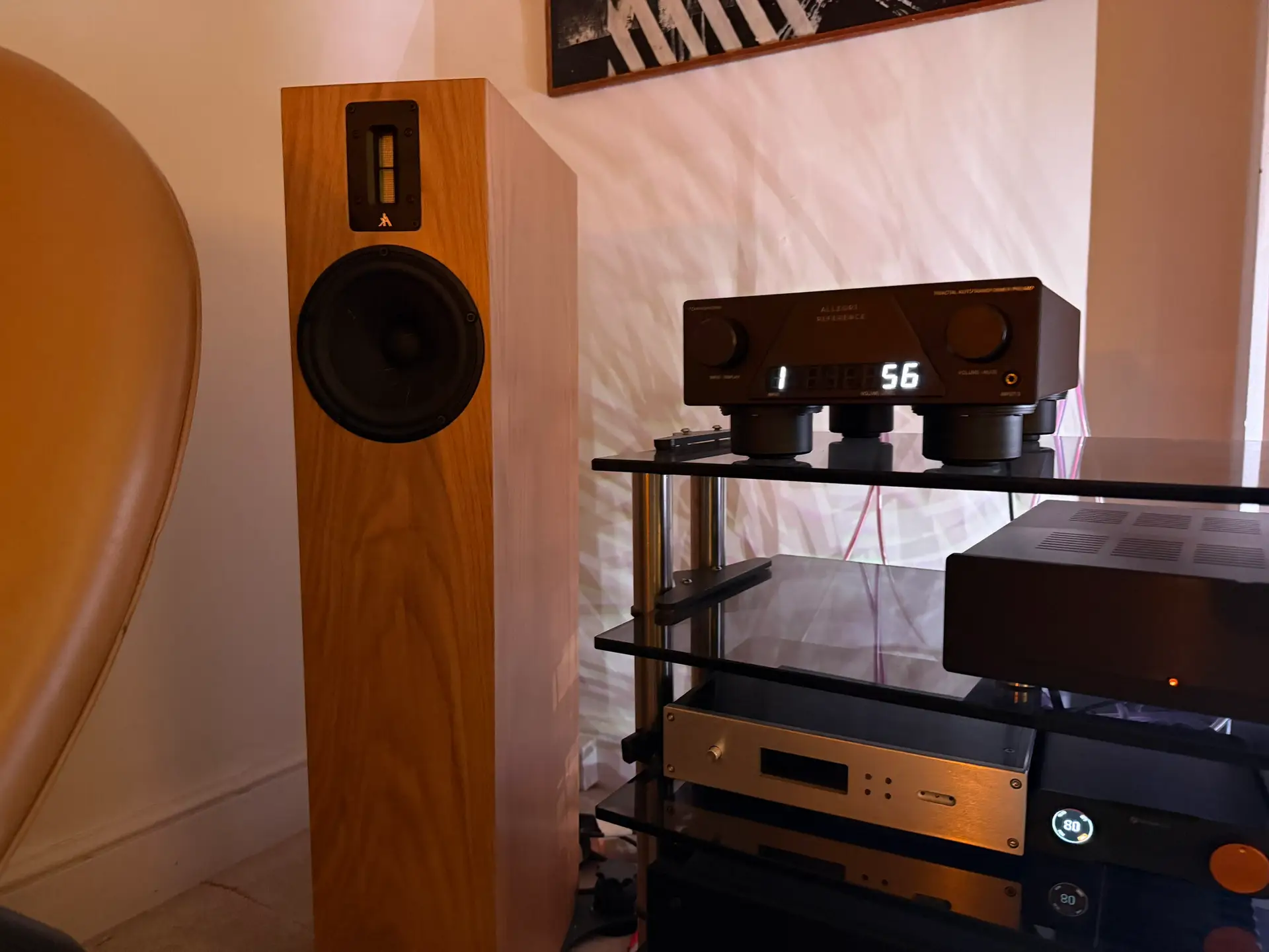
Jonathan Gorse Reviews the Townshend Allegri Reference
“There isn’t anything else quite like it in high-end audio.”
We are delighted to share Jonathan Gorse’s in-depth review of the Townshend Audio Allegri Reference preamplifier, published by SoundStage! Ultra.
The Allegri Reference has always been a rather unconventional preamplifier. In fact, as Gorse puts it:
“The Townshend Audio Allegri Reference is certainly the most unusual preamplifier I have ever reviewed.”
That difference goes right back to the thinking of our founder, Max Townshend, who regarded the Allegri as one of his greatest achievements.
A different approach to the preamplifier
Most preamplifiers use active circuitry based around transistors or valves. The Allegri takes a fundamentally different approach.
At its heart is an autotransformer volume control (AVC), allowing the music signal to be controlled without passing through a conventional active amplification stage. The objective is beautifully simple: interfere with the original signal as little as possible.
The Allegri Reference combines this principle with 0.5dB volume steps, hermetically sealed reed relays, Townshend Fractal wire and mechanical isolation, creating an extraordinarily minimalist signal path.
Its measured bandwidth of 8Hz–80kHz (±0.1dB) gives some indication of the engineering behind it. But measurements only tell part of the story.
What happens when you listen?
This is where Gorse’s review becomes particularly interesting.
Across a wide range of recordings, he repeatedly returns to the Allegri’s transparency, absence of grain, dimensionality and ability to reveal the natural character of a recording.
Listening to Buckingham Nicks, he describes a “gorgeously liquid sonic signature” that manages to be both transparent and smooth. More strikingly, he describes the Allegri as:
“Probably the most three-dimensional preamplifier I have ever heard.”
That sense of space extends beyond simply producing a wide soundstage. Gorse describes performers occupying clearly defined positions with both depth and width, creating an unusually convincing impression of musicians existing within the listening room.
Silence, transparency and dynamics
Passive designs are sometimes associated with compromises in dynamics or drive. Gorse’s listening experience suggests something rather different.
With Duran Duran’s Liberty, he notes the power and drive of the drums and compares the Allegri favourably with his Naim preamplifier, finding the Townshend less grainy.
Lee Morgan’s The Sidewinder reveals another side of the Allegri. Gorse highlights its “stunning transparency”, explosive dynamics and exceptionally low noise floor, allowing instruments and the acoustic space around them to emerge from remarkably quiet backgrounds.
The Blue Nile’s Hats further demonstrates the Allegri’s ability to uncover fine detail and vocal expression without turning that information into an analytical or clinical presentation.
His conclusion is wonderfully simple:
“There isn’t anything else quite like it in high-end audio.”
A very Townshend way of doing things
Perhaps that is what makes this review particularly satisfying for us.
The Allegri Reference was never designed to follow conventional thinking about what a high-end preamplifier should contain. Max approached the problem from the opposite direction: what can we remove from the signal path while still giving the listener complete control?
That philosophy runs throughout Townshend Audio. Rather than adding complexity for its own sake, we try to identify what is getting between the recording and the listener, then engineer it out.
Jonathan Gorse’s description of the result captures that beautifully: extraordinary imaging, exceptionally low noise, transparency and a natural, tangible presentation of music.
His final verdict?
“It’s a compelling option at any price.”
We think Max would have rather enjoyed that.
Read Jonathan Gorse’s complete review of the Townshend Audio Allegri Reference at SoundStage! Ultra.


